Network + Self-Organizing + Location + Data Visualization = 2010
I've been playing in a sand box to explore online collaboration/social media tools and how they support network weaving. The big ah ha for me during our reflection that was that effective online collaboration tools for working in a networked way can't have top-down control interaction design. This gets in the way of everyone being able to do a little bit of work. It isn't just about tool features, you have to understand how working in a networked way is embedded in the interaction design of the tool.
I think it is more than just having self-organizing values embedded in the way the tool works. I think these are four qualities to look for:
- Network: This is a collection of people and organizations that linked together. It's your professional social network or a network of organizations or typically both.
- Self-Organizing: The ability for people to work together without a centralized or top down coordinator. It means letting go of control and letting others help you.
- Location: We are no longer tethered to our desktops or offices, but with mobile phones, GPS, and other "where" technology, location is important.
- Data Visualization: Given the volume of information and our ability to connect with more people, in order to manage our work visualization is now critical. This comes in the form of maps or other creative ways to see our networks.
It's funny how you discover an insight and then apply that lens to what you're seeing and patterns emerge. I've come across three different tools that embed these principles. These ideas are going to have an impact on the way nonprofits use the Web in 2010 and into the next couple of years.
Lucy Bernholz tipped me off to Groundcrew is a web/mobile software that organizes groups of people in real time in real life to work on projects and allows for complex coordination of tasks and communities. As the name implies, it is a way to turn the crowd into a crew. Network members can see who is available to help at any moment and can quickly communicate assignments to help people work together. This is a synthesis of real time tracking with real time coordination.
Stowe Boyd did a video interview and analysis and comments on the "participation design"
I am particularly impressed by the self-organizing qualities of Groundcrew, around 'participation design', where the volunteers are handed more control about how their involvement should be applied in some project or activity, instead of just being told what to do.
I haven't played with it because the tool isn't free (after 30 day trial). I don't want to fall into the "if you build they will come" trap. This tool might work best for organizations that have already built a network on Twitter or Facebook – and could import their friends into the system or have a way to identify people in a geographic area who have an interest in their project or work.
This tools like a good match for organizations that have the networked mindeset – value self-organizing and open participation. I'm thinking about organizations such as 350 or Moms Rising. For more traditional institutions that have worked in a particular way, embracing this tool might require addressing some cultural/change management issues first.
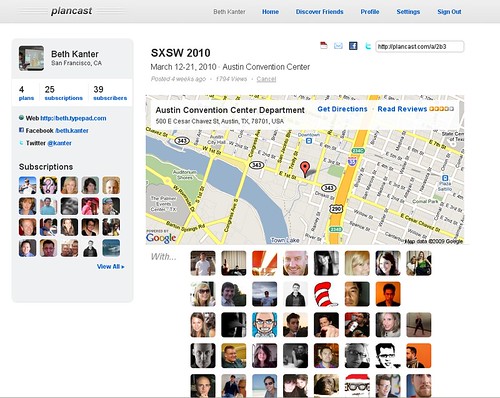
My Plancast for SXSW Session: Crowdsourcing Social Change
Rejoignez PSST ! La plateforme d'échanges interprofessionnelle !
envoyez nous vos actualités + inscrivez vous a la newsletter : www.psst.fr
SOURCE : beth.typepad.com
PAR: alexis mouthon
ACCÈS DIRECT A LA PLATEFORME: PSST.FR
UNE INITIATIVE DE: POURQUOI TU COURS?
AGENCE DE PLANNING STRATEGIQUE 2.0
DIRIGÉE PAR: Jérémy Dumont
 NOUS SOMMES VIVANTS, LE COLLECTIF DE LA TRANSITION ÉCOLOGIQUE
Laisser un commentaire