A canvas and a series of workshops to define your impact strategy and design new products/services based on regenerative practices with your network of partners.

The regenerative economy
The trend is towards relocating economic activities and strengthening ties with stakeholders in an uncertain context. Regeneration appears essential to the resilience of economic activities in their territories and to the regeneration capacity of the living on which they depend. We have developed the business model canvas of the regenerative company to enable them to take their responsibilities .
The regenerative economy relies on the economics of mutuality to set a contributory course for a coalition of actors with a regenerative aim united beyond economic profit alone. “We know that businesses need financial capital, but they also need other forms of capital, such as human, social, and natural capital. So why would we maximize the production of financial capital at the expense of others? We also know that the creation of financial capital is based on power relations. But what if we instead tried a system where the relationship is based on mutual relations?” Bruno Roche Economics Of mutuality
All economic activity assumes mutual benefit, and an economic optimum can be defined as a situation in which the individual benefit of the parties is maximized for a maximum mutual surplus. The economic analysis of mutual benefit opens the field for a mutualist economic theory as an alternative to standard economic theory. For a mutualist economic theory, profit versus mutual surplus
This pursuit of mutually beneficial advantage drives the mission-driven enterprise by enabling the establishment of a regenerative ambition with all stakeholders in an economic activity. Individual positive impact will be maximized by collective regenerative action.
This collective impact requires another level of collaboration and a structured process that leads to a common program, a set of shared practices and mutually reinforcing regenerative actions between all the actors in this regenerative coalition.

Towards the regenerative enterprise
In this new economic logic, the company, led by a coalition of stakeholders with a regenerative aim, delivers socio-ecosystem services to a territory: climate, water, soil, biodiversity, nutrition, fair remuneration, education, etc.
These services provided by humans to nature aim to restore vital resources to enable living beings (including humans) to reach their full potential within their ecosystem. This is our definition of regeneration.
Our belief is that businesses with a financial focus are shifting from one economic model to another at the level of their products and services. Digital transformations hold many lessons for the ecological transition. It’s only once the turnover from companies’ digital activities has reached a certain profitability threshold that they have invested massively in digital technology and truly transformed themselves in depth.
Thus, transforming one’s business model involves abandoning harmful projects and launching regenerative products, services, and projects. Products that integrate, from their very design stage, the company’s responsibilities toward nature and future generations. Products that will contribute to the regeneration of nature (including humans) within 5 to 10 years while remaining economically viable in the short term. Products that will gradually transform the company into a regenerative enterprise as innovations are launched. Products and services resulting from regenerative practices. By measuring the impacts of these new practices implemented. Not to mention the projects led by local authorities that contribute to the quality of life of residents in new mutually beneficial relationships.
The design of regenerative offers
Regenerative design allows for the integration of environmental and social issues, alongside economic ones. What’s new about regenerative design is the search for contributory impacts beyond net-zero impacts, the ability to leverage these contributory impacts, and increased collaboration between stakeholders in the supply chain at the local level.
Our approach to regeneration is sector-specific. When it comes to practices, it is primarily based on organic and regenerative agriculture. Regenerative agriculture provides socio-ecosystem services such as healthy living soils or above-ground biodiversity, animal welfare, and fair compensation for producers. It holds many promises, not only environmental promises, but also social promises with economic results for farmers. The practices are certified by third-party organizations. We draw inspiration from two other sectors— regenerative architecture and regenerative tourism —two sectors that have established the principles of regenerative design based on the design of living systems.
The pioneering organizations of the regenerative movement are directly linked to nature (agri-food, alcohol including wine, textiles, cosmetics, perfumery, tourism, construction, etc.) and have implemented virtuous practices towards both nature and humans: reduction of greenhouse gas emissions, water preservation, ethical supplier charter, circular economy (plastic, etc.). Discover the laurels of the regeneration of life 2024. Opening of the laurels of regeneration 2025
This does not mean that regenerative practices are ineffective for organizations with a lesser connection to nature. Any business led by a group of individuals and organizations, regardless of its economic sector, is connected to nature, dependent on the resources of a territory and a space for human interaction. Every business must be responsible. Firstly, because adaptation strategies must be put in place to face future risks. And also to increase their capacity to seize future opportunities by identifying the regeneration potential of a territory and maximizing symbiotic relationships between humans and non-humans in order to live better together on Earth. The future is not already written, it is being written together.
Regenerative practices must be certified by third-party organizations based on specifications. Both degenerative and regenerative impacts must be measured and transparently communicated to consumers, users, and residents.

The business model canvas of the regenerative enterprise
Our Regenerative Enterprise Business Model Canvas – the REGEN BMC – helps identify new products and services to launch as part of a mutually beneficial regenerative approach with a range of stakeholders. Or, it helps a local authority bring together local stakeholders around a single economic player.
With the laurels of regeneration, we have shown that regeneration translates into products and services with a positive impact in several sectors of activity in France. Products and services with an economically viable impact. And defines the conditions for success. Article
Innovation aligns with the CSR objectives of reducing negative impacts AND/OR maximizing positive impacts below.

It is a process structured over 5 workshops that allows each entity involved in the value chain of a product / service / project to integrate the socio-economic services to be provided into its own area of responsibility, in particular via specifications. Each stakeholder is thus able to anticipate the new practices to be implemented in a shared governance. A transformation plan makes it possible to organize the shift towards regenerative over 5 to 10 years and thus transform the entire organization on the basis of resilient, contributory and viable activities.
In line with the new CSRD directives, the regenerative company business model canvas allows CSR departments to measure their impacts and establish an operational framework with internal and external stakeholders in order to limit risks and negative impacts and highlight their contributions at the level of a territory such as France or the different countries in a sector.
The REGEN BMC enables innovation departments to reconcile the resilience of economic activities and the regeneration of nature with a transformation plan supported both internally and by key partners in the product and service innovation value chain.
The REGEN BMC finally makes it possible to bring together all the inhabitants of an area around a regenerative project led by the local authority, the only one capable of bringing together all the stakeholders in a common interest.
Experience the regenerative business model
One of the major advances in Regen BMC V5 is the redesign of the canvas and the clarification of the workshops that allow you to complete the REGEN BMC during a consulting assignment. You can attend a masterclass/discovery session and learn how to facilitate our workshops in consulting mode.

Workshop 1: Analysis of the current product/service value chain
Identify areas of degeneration at each stage, good practices and opportunities for ecosystem services to be delivered with stakeholders (CSRD standards).
2. Workshop 2: Redesign of the future value chain of the offer to be launched
Define who the strategic partners are to be mobilized to deliver this new service while contributing to the socio-ecosystem services targeted in 10 years.
Workshop 3: Regenerative value proposition (regenerative co-design)
With all stakeholders, co-design the regenerative value proposition that maximizes environmental, social and financial capital to prosper in 10 years.
4. Workshop 4: Strategic Planning
Develop a three-timeframe action plan to organize the transition to regenerative service, with a switchover within five years: feasibility and viability. Cost and benefit assessment.
5. Workshop 5: Measuring and monitoring impacts in triple accounting
Define clear indicators to assess progress and regenerative benefits in triple accounting.
Three-hour or one-day discovery versions already exist for a food product, a textile product, wine, and a digital service. Other sector-specific versions are being designed, for example, in architecture and the social and solidarity economy.
Upcoming Masterclasses and Discovery Sessions
Train yourself in the animation of the regenerative business model
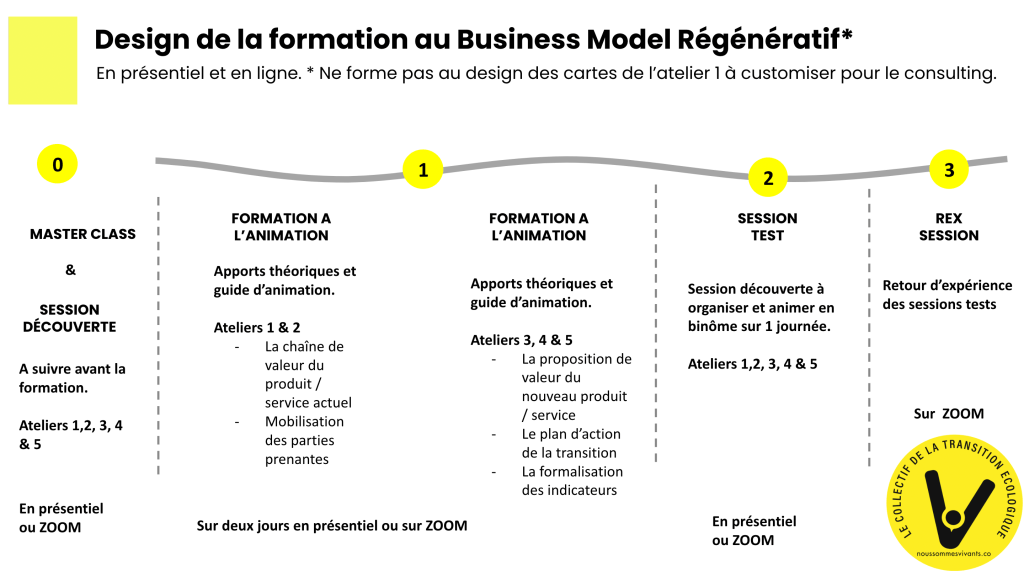
Detailed sheet of the training for leading the 5 workshops
Ask us for a quote to deploy the regenerative business model
What our clients ask us is: to help them define their CSRD strategy, explore new business models, design impactful innovation, bring their stakeholders on board, and define an eco-model around certification.
Across a broad spectrum of indicators, from carbon to biodiversity to quality of life at work. By bringing together business lines within the company or by bringing together all of its stakeholders from end to end of the value chain.
For businesses: The REGEN BMC sectoral discovery version is presented in the form of a one-day, in-house, introductory session. The REGEN BMC sectoral consulting version is delivered in five one-day workshops to meet the specific needs of businesses and local authorities mobilizing a coalition with a regenerative focus.
We charge €5,000 for the RegenBMC introductory in-house training and between €20,000 and €30,000 for consulting (depending on the number of workshops and days of training). The training is led by two facilitators: a sector expert and a mediator.
Our references: Regenerative Enterprise Business Model Canvas – RegenBMC
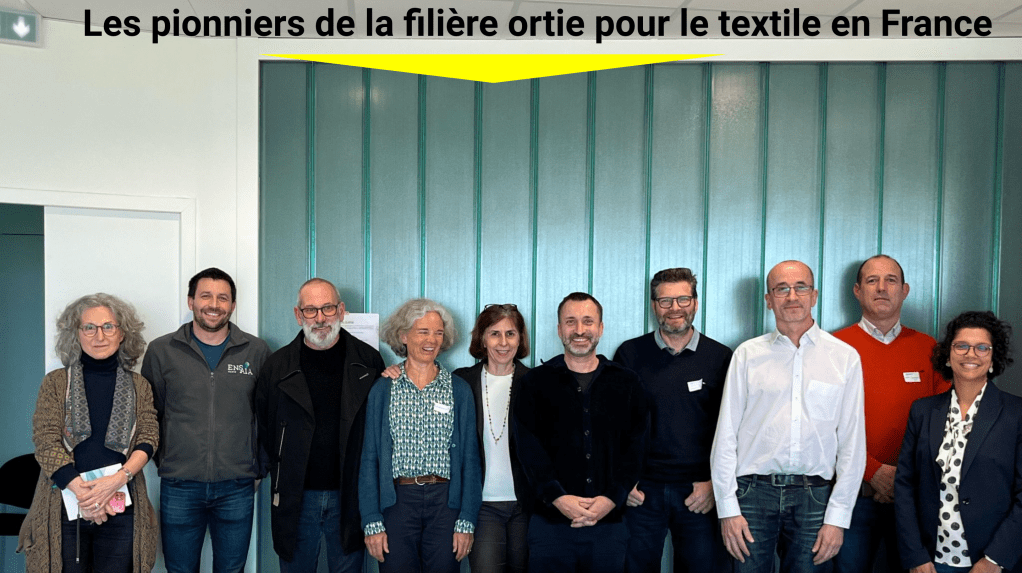
We have begun co-building the foundations of a regenerative business model for nettle in textiles. We have been supporting this sector for three years . https://lnkd.in/emEE6txSRead the feedback
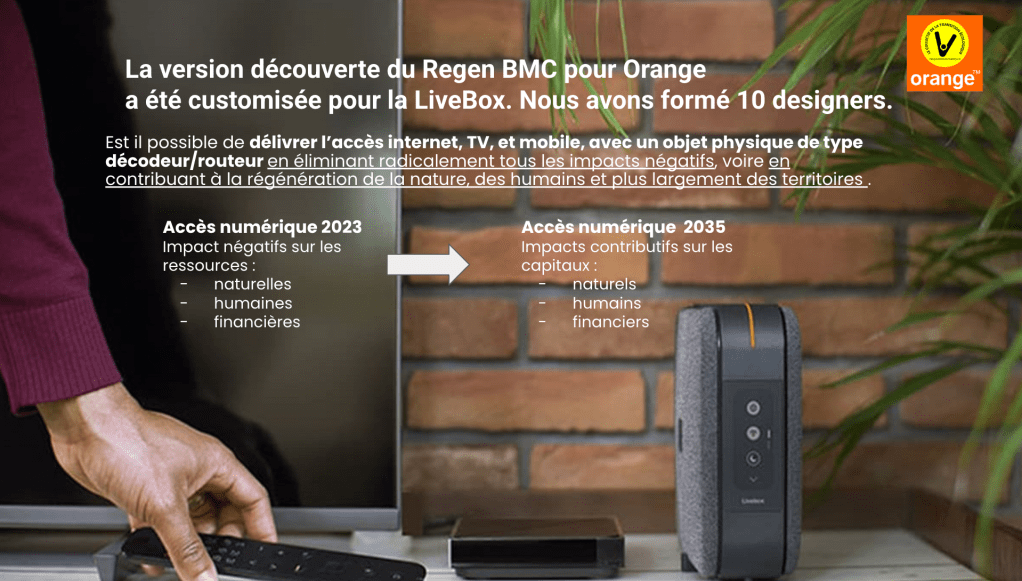
The discovery version of Regen BMC for Orange has been customized for services delivered via LiveBox. We trained Orange designers on Regen BMC to help them establish an impactful innovation method in connection with the CSRD. HERE
Exploring consumer expectations in France and the USA for a future range of products based on regenerative practices. The mission took the form of a learning expedition to engage internal and external stakeholders.
PLAN OF THE PRESENTATION TO THE COMEX
1- What is regeneration?
2- Regeneration for MELVITA?
- 2-1 MELVITA Regenerative Brand Platform
- 2-2 Business benefits for MELVITA
3- Other business models to explore under the regenerative skincare brand?
4- Melvita, a company with a regenerative aim, how to get there in 3 steps with RegenBMC.
Articles to go further
- Move towards strong sustainability by establishing its CSRD strategy and innovating by aiming for regeneration HERE
- Scientific research work that establishes what regenerative business models are in comparison with sustainable and circular models (ICI)
- Regenerative design of products and/or services HERE
- Ecology is expensive when we pay the price for the inaction of others (textile focus) HERE
- Brands that have launched regenerative products or services in France HERE . With the 2024 Regeneration Awards 30 winners
- Sector focus on regenerative brands and products in France: regenerative food , regenerative fashion , regenerative beauty , regenerative wine and champagne and organic and regenerative chocolate Other sectors advanced on regeneration in France: regenerative tourism and regenerative architecture (including construction).
- Digital Focus and Startups: Can digital technology aim to regenerate living things within the framework of the CSRD? HERE And impactful startups in the food sector are part of the solution.
- Brands that have launched regenerative products in the USA (LA). And the details in 5 parts
- PART 1 – THE CLIMATE SOIL STORY
- PART 2 – POSITIVE FOOD FROM REGENERATIVE AGRICULTURE
- PART 3 – LOCAL REGENERATION
- PART 4 – RECONNECTING WITH NATURE
- Telling the complete regenerative story: the regenerative concept on products and the involvement of all stakeholders HERE
- The pioneering brand of regeneration PATAGONIA: what transformation plan framed by triple accounting HERE
- From regenerative agriculture to the business model canvas of the regenerative enterprise HERE .
- Focus on labels: New regulations . Regenerative Organic Certified (ecocert), Planet-score, Nutri-score .
- Transformation focus: regenerative leadership and giving nature and future generations a seat on its board of directors
- Legislative point and greenwashing HERE
Pitch in English for CHANGENOW 2024
Do you have little knowledge on the subject?
To get started with regeneration :
- What tools and training (sometimes free) do regeneration stakeholders in France offer HERE
- Understanding the main principles of regenerative business with the regenerative business fresco
- Understand the 4 major avenues of innovation including regeneration with the fresco of imaginations
- What impacts does the CSRD have on my company’s value chain with the impact box?

Our references on the Regen BMC



 NOUS SOMMES VIVANTS, LE COLLECTIF DE LA TRANSITION ÉCOLOGIQUE
Répondre à REPLAY : les produits issus de pratiques régénératives aux USA connaissent un succès commercial tout en régénérant le vivant. – NOUS SOMMES VIVANTS, LE COLLECTIF DE LA TRANSITION ÉCOLOGIQUE Annuler la réponse.